







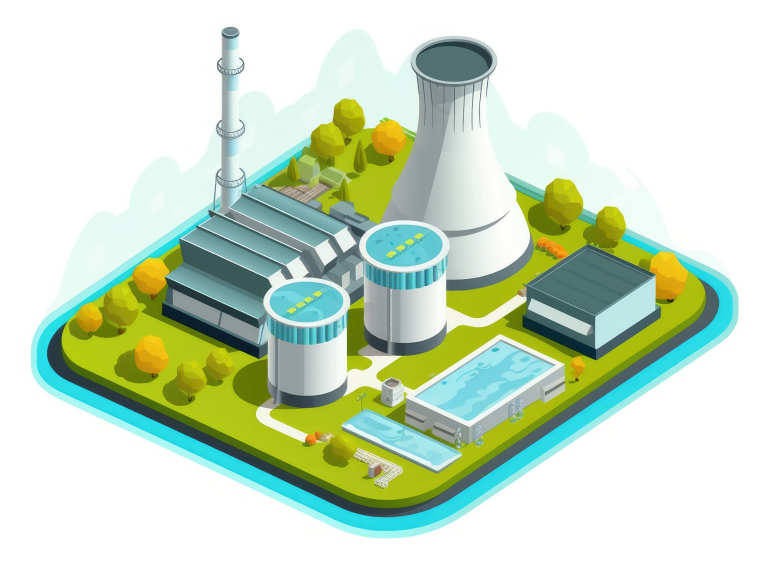

They organize the main topics of PSR’s activities in the energy sector.
They represent practical applications within each area of expertise.
Check out the release notes for NCP 5.28
NCP is a short-term operational optimization model that determines the lowest-cost dispatch of energy systems in hourly or sub-hourly intervals (30, 15, or 5 minutes). The planning horizon ranges from a few hours to two months ahead. Common applications include day-ahead, week-ahead, and re-dispatch planning. NCP can also be used to define dispatch strategies aimed at maximizing revenue for energy companies in competitive markets.
Target storage, target generation, terminal function.

Common applications include day-ahead, week-ahead, and re-dispatch planning.

Including nested reserve modeling.
Upstream level and flow ramps, inertia provision, unit dispatch, net head, yield curve, etc.

Non-linear thermal yield curve, startup costs, cogeneration (CHP) modeling, forbidden zones, etc.
Full cycle efficiency, charge and discharge ramp constraints, maximum regulation time.

For renewable sources, storage devices, thermal, and hydropower plants.

Price response, signals by segment, by system, by area, or by bus.

Largest generator contingency, system inertia, interconnection flows, absolute limits.

And much more…
Short-term planning must reflect real system conditions.
Represents a wide diversity of elements and constraints.
Generates intuitive results and facilitates qualitative analysis.
NCP can be integrated with medium and long-term models, such as SDDP, by reading a terminal function (future cost or benefit function) for a specific week or month. It considers all elements modeled in SDDP, plus additional information from operations in sub-hourly periods.
The short-term energy planning tool is formulated by NCP as a large-scale mixed-integer linear programming model. The problem is solved with state-of-the-art optimization techniques for Linear Programming and Mixed-Integer Linear Programming (including strategies like Branch & Bound, branch & cut type cut generation, and heuristics).