






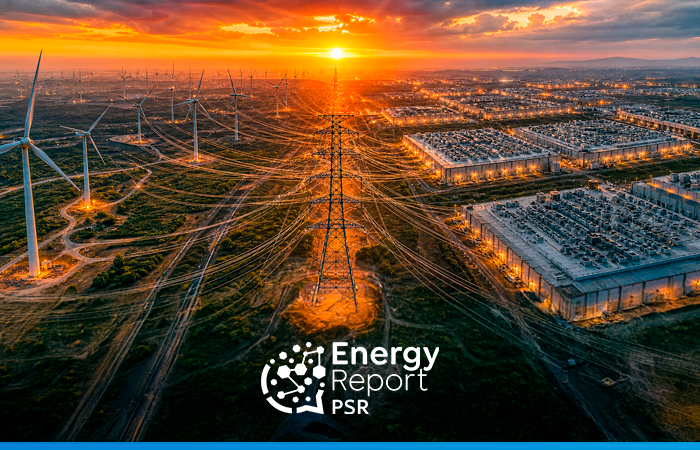
In recent years, the expansion of the electricity grid has been strongly associated with the growth of renewable generation and the need to transport energy to consumption centers. However, recently a new dynamic has begun to gain global prominence: the race to connect large, energy-intensive loads, especially data centers driven by advances in artificial intelligence.
This is the starting point of the Opinion section of the April edition of the Energy Report, which analyzes the challenges and opportunities associated with connecting these new loads to the electricity system and the impacts of this transformation on transmission planning and regulation. The editorial highlights that the debate now revolves around a new question: where, how, and within what timeframe will it be possible to connect large consumers with increasing demands for quality and speed of supply?
The text explores how the pressure on the electricity infrastructure is intensifying in the face of the accelerated growth in demand for computing capacity. Large-scale data centers, often in the hundreds of megawatts range and, in some cases, gigawatts, are posing new challenges to traditional system access processes, both due to the magnitude of the loads and the aggressive deployment schedules.
At the same time, the editorial contextualizes this movement within an international scenario marked by growing connectivity bottlenecks. In mature markets, such as the United States, long queues for network access, equipment shortages, and infrastructure limitations are already beginning to delay projects related to artificial intelligence. In this context, countries with abundant energy, renewable energy sources, and robust systems are being seen as strategic potential assets.
The report highlights, however, that transforming this potential advantage into competitiveness will require structural advances in the network access model. Among the paths discussed are mechanisms to value faster connections, greater transparency regarding so-called connection hotspots, and the recognition of the flexibility of large loads as a relevant attribute for expanding system access capacity.
The editorial discusses how the biggest challenge for the electricity sector has become dealing with increasingly complex decisions regarding location, connection speed, and coordination between grid expansion and demand growth.
The April edition of the Energy Report is now available to subscribers.
Other highlights of this edition:
- Regulatory – Relationship between difficulties in trading companies and regulatory issues
- Water Resources – The risks of rare earth mining for water resources in Brazil
- Energy Transformation – We evaluate “sustainable” debt, such as green bonds and sustainability-linked bonds
- International – The international section analyzes the new regulation for storage systems in Mexico
- Innovation – We analyze two startups that are the market’s “Plan B” if Big Labs do not achieve AGI
- Geonomics – Gas price increases marginal cost and may impact tariffs and inflation with greater thermal dispatch
- The Material World – Mineral sovereignty: strategies for the path to self-sufficiency in phosphorus and potassium in Brazil
- Structural Analysis of Supply – Presents the updated balance of structural energy demand and supply for the coming years and our traditional Delay meter.
The Energy Report is a PSR publication exclusively for subscribers. Suggestions and comments can be sent to energyreport@psr-inc.com