







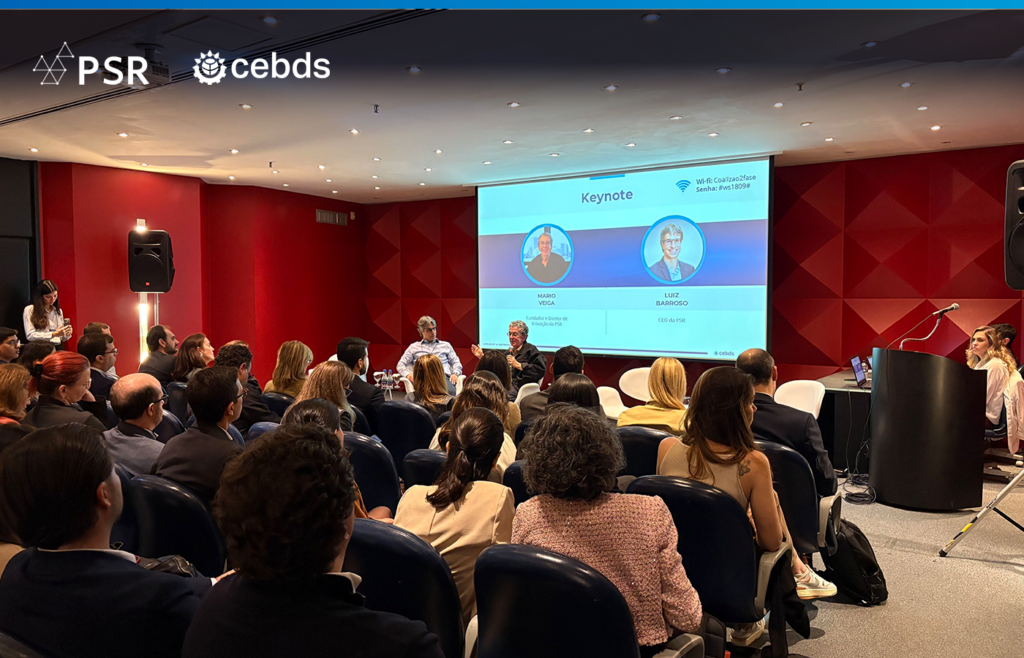
In September, the Electric Sector Coalition launched the series of thematic workshops for its second phase. The first meeting, focused on electrification, brought together approximately 120 representatives from companies, associations, and the government in Rio de Janeiro to discuss expanding the use of electricity in industry and transportation, as well as the impacts of electrification on the electric sector itself. The Coalition is an initiative led by the Brazilian Business Council for Sustainable Development (CEBDS) and coordinated by PSR, with the support of sector institutions.
The workshop followed up on discussions from the 1st Convergence Forum, held in August, which—among other issues—identified electrification as one of the four key focus areas for the Coalition’s new phase. In this specific instance, it is a cross-cutting area involving other economic sectors, such as transportation and industry. Discussions have been taking place across various levels of the project, ensuring representation for the companies and entities involved.
The agenda began with a debate on the evolution of global electrification costs and technologies that are already competitive in Brazil—such as solar, wind, and storage—including newer solutions like thermal batteries for industrial heat, a segment that accounts for approximately 30% of global energy consumption. According to PSR CEO Luiz Barroso, it is crucial to translate these discussions into concrete guidelines to steer the Coalition’s work.
Regarding industry, one of the topics discussed was the role of the Brazilian Emissions Trading System (SBCE), established by law in late 2024 and scheduled for gradual implementation. This mechanism could incentivize electrification projects in sectors such as mining, pulp and paper, chemicals, and steelmaking. In these sectors, electricity still accounts for only a fraction of total consumption, as some thermal processes rely on fossil fuels. The discussion highlighted the need to align industrial and energy policies and to create mechanisms that stimulate electricity demand—an area that has historically received less encouragement than supply expansion.
The transport panel presented projects for electrifying highway corridors and urban fleets, with targets to increase electric truck trips on major highways and decarbonize municipal bus fleets by the end of the 2030s. The cases analyzed underscored financing and demand aggregation as key factors in making the replacement of conventional vehicles feasible, given that capital costs remain a significant barrier.
In the electricity sector, the discussion highlighted the contrast between Brazil’s favorable conditions — with a generation mix that is nearly 90% renewable, compared to a global average of around 40% — and the challenges regarding energy costs: over R$ 60 billion in subsidies embedded in tariffs, alongside price signals that do not reflect actual system costs. The conclusion was that, to turn these opportunities into reality, coordinated action is required on three fronts: investment in grids and infrastructure planning, price signals that better reflect actual supply costs, and governance structures capable of lowering investor risk perception.
The convergence of clean energy, competitive costs, and growth potential is a rarity globally, and the country needs to capitalize on it more broadly and effectively for the benefit of both its economy and the global climate.
“It became clear to all of us that the electricity sector faces a massive challenge—whether regarding price signals, transmission technology, planning, or resilience. If this isn’t effectively addressed, all the ideas we’ve discussed here will amount to nothing more than empty rhetoric,” stated Barroso.
The insights gathered during the workshop will be incorporated into the project’s next stages, which include three additional thematic meetings focused on flexible resources, resilience, and price signals and subsidy rationalization. The Coalition is supported by ABRADEE, ABRATE, ABRACE, ABEEólica, ABIAPE, ABRAGE, Axia, Engie, Energisa, Neoenergia, EDP, and CPFL.