



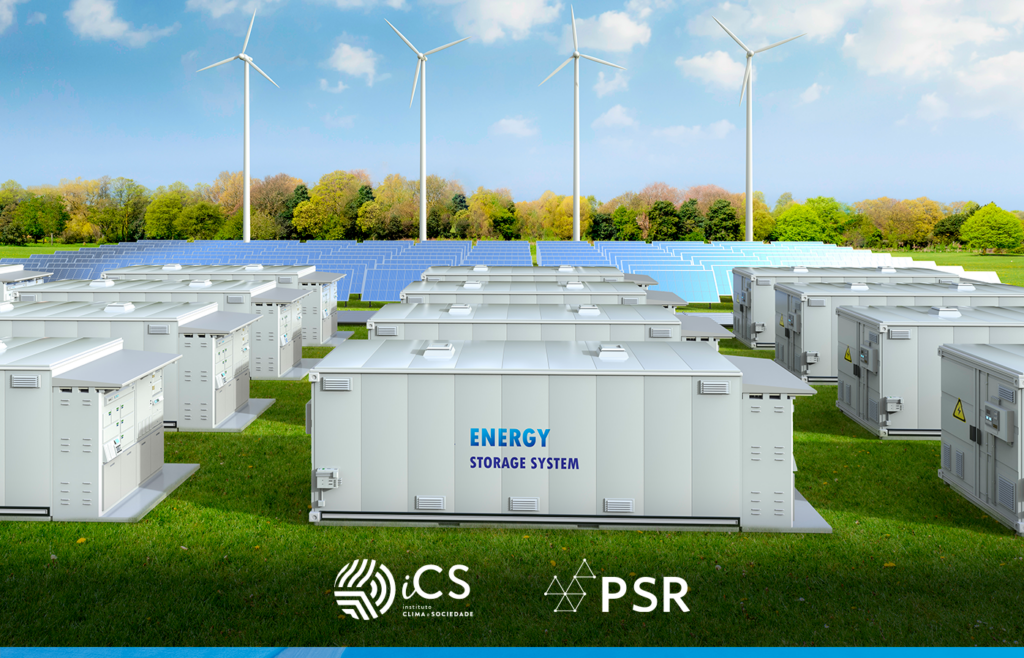
The growing participation of renewable sources in the Brazilian electricity mix has been significantly impacting the operation of the electrical system, creating new challenges related to the flexibility, reliability, and security of supply. With this in mind, energy storage systems are emerging as one of the main technologies to support the energy transition and expand the integration of sources such as solar and wind power.
With the aim of contributing to this debate, PSR, in partnership with the Climate and Society Institute (iCS), developed the project “Models for Efficient Integration of Energy Storage in the Brazilian Electrical System”. Over the past few months, the initiative has resulted in five complementary studies that analyze everything from the current challenges of the electricity sector to the socioeconomic impacts of expanding storage in the country.
Based on a broad literature review and interviews with stakeholders, the series of reports offers a technical and in-depth overview of the topic, bringing together technical, regulatory, environmental, and social analyses to support policymakers, electricity sector agents, investors, and others interested in the development of this technology in Brazil.
The first study assesses the current context and future challenges of the Brazilian electricity system, highlighting how the growth of variable renewable generation increases the need for resources capable of providing flexibility, power, and ancillary services to the system. The report also explores the different applications of storage systems in generation, transmission, distribution, and isolated systems.
The second report then analyzes international experiences in countries such as China, the United States, Australia, Chile, and India. The survey identifies public policies, incentive mechanisms, remuneration models, and industrial development initiatives that can serve as a reference for building the Brazilian energy storage market.
The third report focuses on the barriers that still limit the integration of battery energy storage systems (BASS) in the country. The study addresses challenges related to the regulatory framework, network access, sources of remuneration, taxation, and environmental aspects, in addition to presenting recommendations to overcome these obstacles and accelerate the adoption of the technology. It is worth noting that some of these barriers were already being discussed by sectoral institutions during the preparation of this series, and have been the subject of new regulations, generally aligned with the recommendations of the study.
The fourth study moves towards the formulation of operational models for integrating storage systems into the Brazilian electricity sector. The document proposes guidelines for enabling priority services, including peak demand, operational flexibility, voltage control and frequency regulation, as well as recommendations related to environmental licensing, operational safety and battery lifecycle management.
Concluding the series, the fifth report broadens the perspective on energy storage by analyzing its socioeconomic impacts. The study discusses how storage systems can contribute to energy inclusion, the strengthening of local communities, income generation, professional training, and the development of national production chains. The document also presents recommendations aimed at promoting a just energy transition, capable of distributing benefits more broadly among different regions and social groups.
By bringing together diagnoses, international references, and concrete proposals for the Brazilian context, the project seeks to contribute to building an environment conducive to the expansion of energy storage, a technology considered increasingly strategic for ensuring the reliability, resilience, and sustainability of the national electricity system.
Access the reports here:
- Report 1: Analysis of the context and challenges of the current and future Brazilian Electricity System (SEB)
- Report 2: Analysis of international experiences
- Report 3: Identification of barriers and proposal of solutions
- Report 4: Formulation of operational models for the integration of storage systems
- Report 5: Evaluation of socioeconomic impacts and strengthening of local communities
See the executive summaries of the reports here:
- Executive Summary Report 1
- Executive Summary Report 2
- Executive Summary Report 3
- Executive Summary Report 4
- Executive Summary Report 5
Also check out the articles in Energia em Foco produced within the scope of the project: