







The increasing integration of variable renewable energy sources introduces new operational challenges for power systems, particularly in terms of flexibility, reliability, and economic efficiency. In this context, battery energy storage systems (BESS) are becoming a promising technology, as they can contribute to meeting these requirements by providing services such as energy arbitrage, operating reserve, and grid operation support. This article presents a methodology for the optimal sizing and cost-benefit assessment of battery energy storage systems and applies it to a case study of the Colombian power system. The proposed approach is based on the results of stochastic operational simulations, identification of candidate locations, and optimization models to determine the optimal capacity and site of battery storage systems.
Determining the optimal storage capacity
The optimal sizing and siting of battery energy storage systems was structured in three main stages:
- Detailed simulation of the operation of the power system using the SDDP model to estimate hourly nodal prices and system operating costs, which serve as a reference for the subsequent analyses.
- Candidate-node screening: identification of potential locations for battery installation using a selection methodology based on intraday nodal price differentials. The nodes (transmission system buses represented in detail in the previous simulation) that present the largest intraday price differences correspond to the locations with the highest potential for the installation of energy storage systems.
- Capacity and siting optimization: optimization of storage capacity and selection of the best locations among the candidate nodes identified in the previous step. This optimization is carried out using the OptGen model, which considers candidate battery projects with different storage and power capacities located at the previously identified nodes. The OptGen model evaluates the impact of incorporating these new resources on total system costs by simultaneously considering investment costs and the reduction in operating costs enabled by the integration of storage systems.
From a centralized planning perspective, the optimal capacity of storage systems is the one that minimizes the total system cost, defined as the sum of investment and operating costs. From an economic perspective, this optimal capacity corresponds to the point at which the derivative of the investment cost for the deployment of storage systems equals the marginal system benefit associated with the reduction of system operating costs, as illustrated in panel (a) of the figure below.
In contrast, in a competitive market context, investment decisions are made by individual agents aiming to maximize their own economic benefits. In this case, the feasibility of the investment depends on the revenues obtained from providing services to the system, such as energy arbitrage and operating reserve provision. Market equilibrium occurs when the expected revenues from storage systems equal the investment costs, as illustrated in panel (b) of the figure below.
 |  |
| (a) Centralized Perspective | (b) Market Perspective |
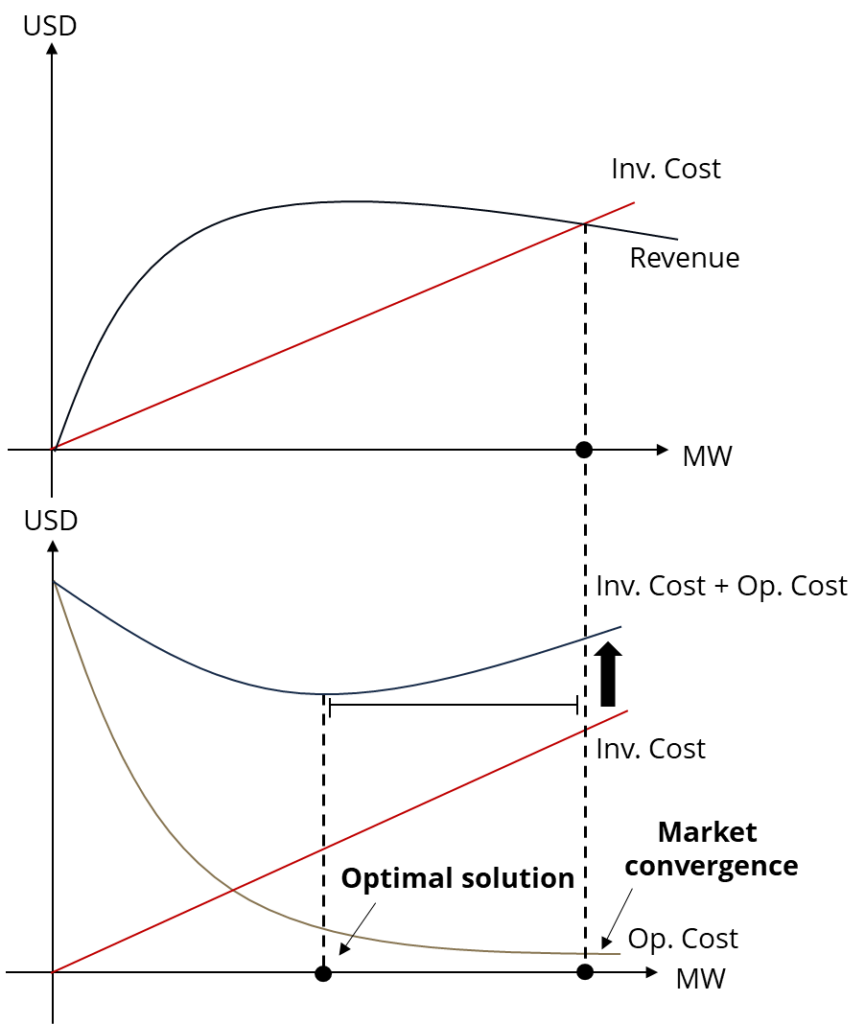
Representation of the distortion in social welfare when fixed availability payments are considered
Can battery energy storage projects be economically viable?
The economic viability of energy storage systems is evaluated through a cost-benefit analysis based on the estimation of revenues obtained from providing services to the system and the investment costs associated with the implementation of batteries.
The main revenue sources considered in the study include: (i) energy arbitrage and (ii) operating reserve provision. Energy arbitrage consists of storing energy during periods of low prices and injecting it into the system when prices are higher, generating revenues from hourly price differentials. Additionally, batteries can participate in the provision of operating reserves, contributing to system reliability and receiving remuneration for their availability and potential activation when required.
The economic evaluation compares the revenues obtained from these services with the annualized investment costs of the storage systems.
Case Study: Assessing the role of batteries in the Colombian power system
The proposed methodology was applied to the Colombian power system planned for the year 2034. In Step 1, a detailed operational simulation of the system was carried out to estimate marginal operating costs for different nodes of the transmission network.
Initially, several candidate nodes in the transmission network were identified for the installation of battery systems based on the results of intraday price differential analyses of the estimated marginal operating costs at different transmission system buses (as described in Step 2). For each candidate location, different storage configurations were evaluated.
The figure below presents a georeferenced map of the results obtained for the different nodes of the system for a given battery configuration. The results indicate that the most attractive locations are concentrated in the central region and along the northern coast of Colombia. These results highlight the locational value of battery storage systems and how they can provide greater benefits to the system when deployed at strategic locations.
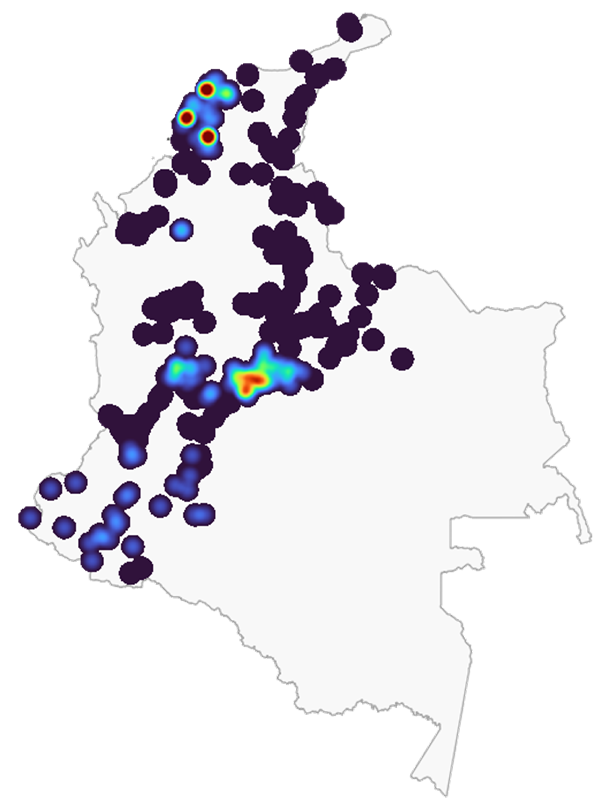
Map of opportunities for batteries
Using the OptGen model, it was possible to determine the optimal level of battery deployment in the system, considering different economic evaluation perspectives. Panel (a) in the figure below presents the system total cost curves as a function of the storage capacity, allowing the identification of the point that minimizes the sum of investment and operating costs. For the conditions analyzed in 2034, the results indicate an optimal deployment of approximately 900 MW of storage in the Colombian power system.
Additionally, the results were evaluated from a market perspective, considering the revenues obtained by storage systems through energy arbitrage and operating reserve provision. Panel (b) in the figure below presents the relationship between expected revenues and investment costs for different levels of battery deployment. It can be observed that, under these conditions, the level of storage deployment from the market perspective coincides with that obtained under the centralized planning perspective. That is, the market equilibrium point, where the revenue and investment cost curves intersect, also occurs at approximately 900 MW.
 |  |
| (a) Total costs | (b) Total revenues |
In addition, scenarios considering additional remuneration mechanisms were also analyzed. As illustrated in the figure below, these mechanisms may affect market economic signals and lead to investment levels above the system-optimal storage capacity.
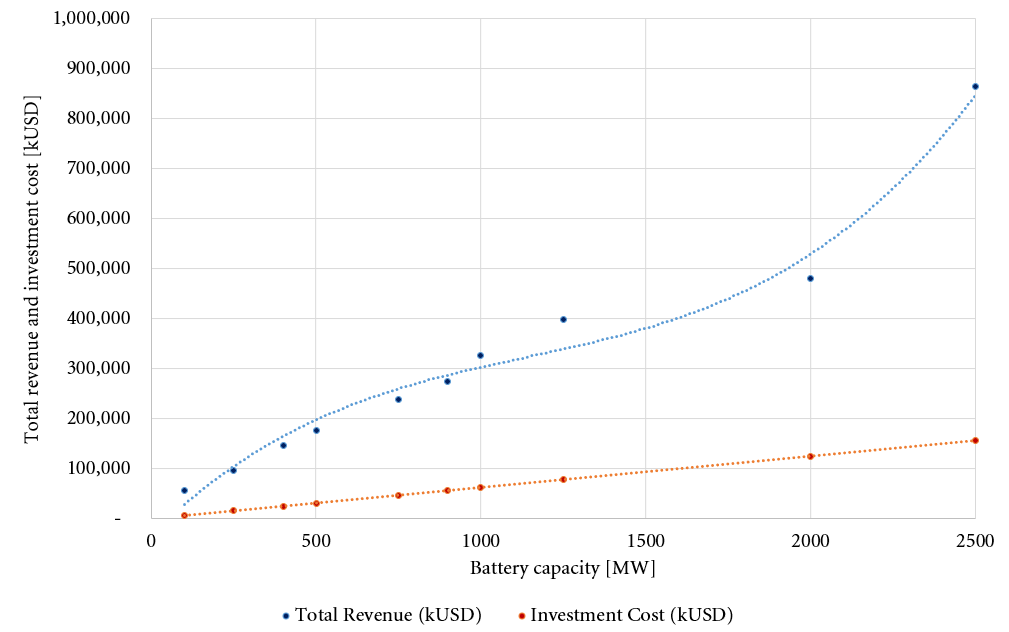
Total revenues for optimal sizing considering fixed availability payments
Based on the results of the optimization model, it was also possible to identify the optimal distribution of storage capacity across different points in the grid. The table presents the allocation of batteries at the main substations of the system for the 2034 scenario, highlighting the locations with the highest system benefit for the integration of these resources.
| Substation | Voltage (kV) | Battery duration (hours) | Capacity (MW) |
|---|---|---|---|
| Porto Nuevo | 110 | 1 | 415 |
| Villeta | 115 | 1 | 75 |
| Cordialidad | 110 | 1 | 178 |
| San Marcos | 110 | 1 | 232 |
Finally, to illustrate the operational impact of batteries on the transmission network, a detailed analysis of the operation of one of the selected locations is presented below. Panel (a) in the figure below presents an example of the hourly operation of the battery installed at the Villeta substation in a day. It can be observed that, during nighttime hours, when there is no solar generation and the available capacity of the transmission lines becomes insufficient to meet the local demand, the battery begins to operate by injecting energy into the system. This discharge helps supply part of the demand during peak-load hours, as shown in Panel (b) in the figure below, reducing the risk of energy not supplied (ENS) and relieving bottlenecks in the transmission network.
 |  |
| (a) Battery operation at Villeta | (b) Representation of ENS at Villeta |
From an economic perspective, a cost-benefit analysis was carried out to assess the financial viability of storage projects at the locations selected by the optimal sizing model.
The table below presents the estimated average annual revenue for each storage system considering revenues derived from services provided to the system, such as energy arbitrage and operating reserve provision.
| Battery (Location) | Storage Capacity (MWh) | Investment Cost [MUSD/year] | Average Revenue [MUSD/year] |
|---|---|---|---|
| Porto Nuevo | 415 | 25.9 | 18.2 |
| Villeta | 75 | 4.7 | 7.0 |
| Cordialidad | 178 | 11.1 | 16.5 |
| San Marcos | 232 | 14.5 | 14.9 |
The results indicate that storage projects are economically attractive across the analyzed locations. In addition, the system-wide benefits associated with the aggregated deployment scenario of 900 MW of storage were evaluated, showing a reduction of approximately 210 million USD per year in system operating costs, corresponding to a benefit–cost ratio of 3.74.
Conclusions
The methodological framework proposed in this article integrates stochastic simulations of power system operation, candidate location screening methods, and investment optimization models to determine the optimal capacity and location of energy storage resources.
The application of the methodology to the Colombian power system indicated that the integration of batteries can provide significant operational benefits, including reduced operating costs, increased system flexibility, and reduced transmission network constraints. Under the assumptions adopted for 2034, the results indicate an optimal storage deployment of approximately 900 MW, distributed across strategic points in the network.
From an economic perspective, the results show that storage projects may present positive financial indicators at certain points in the network, particularly when different revenue streams associated with services provided to the system are considered. The analysis also shows that additional remuneration mechanisms may influence investment economic signals and modify the economically attractive level of storage deployment.
Overall, the results reinforce the potential role of battery energy storage systems as strategic resources to enhance the flexibility and reliability of the Colombian power system. The proposed methodology can serve as a supporting tool for planning studies and for the design of policies that promote the efficient integration of storage technologies in the power sector.
Further details on the proposed methodology and its application to the Colombian power system are available in the report titled “Energía flexible para el futuro: integración del almacenamiento en el sistema eléctrico colombiano” (Binato et al., 2026) .
² Binato, S., Bastos, J. P., Maldonado, C., Morais, W., & Xavier, J. (2026). Energía flexible para el futuro: integración del almacenamiento en el sistema eléctrico colombiano. Planas, A., Malagón, E., Casas Bautista, C. D., & Cárdenas Valero, J. C. (Eds.). Available at: https://publications.iadb.org/publications/spanish/document/Energia-flexible-para-el-futuro-integracion-del-almacenamiento-en-el-sistema-electrico-colombiano.pdf