





The Northwest Power and Conservation Council (NWPCC) is a U.S. interstate agency responsible for developing a regional power plan for the Pacific Northwest. Every few years, the Council produces a comprehensive plan that sets the direction for how the region should meet its future electricity needs over a 20-year horizon, balancing cost, reliability, environmental policy, and risk.
The upcoming Ninth Power Plan represents a major shift in the Council’s analytical approach. Recognizing that the power system’s growing complexity — driven by increasing variable renewable penetration, evolving clean energy policies, and uncertain demand trajectories — required a more integrated modeling framework, the NWPCC adopted OptGen and SDDP, developed by PSR, as core tools for its regional capital expansion analysis.
In a recent System Analysis Advisory Committee (SAAC) meeting held in January 2026, the NWPCC team presented and discussed the full analytical structure being used to develop the plan. This article summarizes how the Council structured its planning problem and the key methodological decisions behind the Ninth Power Plan.
The Northwest planning challenge
The Pacific Northwest power system is dominated by a large hydroelectric fleet, complemented by growing shares of wind and solar generation and a diverse portfolio of thermal, storage, and demand-side resources. Planning this system over a 20-year horizon involves navigating several layers of uncertainty simultaneously: hydrological variability, variable energy resource (VER) availability tied to weather patterns, different demand trajectories reflecting different climate and electrification assumptions, and natural gas price streams.
On top of this, the region faces a rapidly evolving policy landscape. Washington State’s Clean Energy Transformation Act (CETA) mandates a transition toward clean electricity, while carbon pricing mechanisms in Washington, California, British Columbia, and Alberta introduce additional cost signals. The Ninth Power Plan must produce a resource strategy that performs well across this wide range of possible futures — not just the most likely one.
The 2021 Power Plan had already identified that the Council’s existing models needed to be updated to address these challenges. In particular, the plan called for models capable of dynamically adjusting reserves for different generation mixes and assessing trade-offs between supply-side and demand-side technologies as part of the expansion decision. After evaluating several alternatives, the Council selected OptGen and SDDP as the foundation for its new regional capital expansion framework.
Translating adequacy into expansion signals
Ensuring resource adequacy is central to any power plan. The Ninth Power Plan uses a set of adequacy criteria that goes beyond a simple planning reserve margin. The criteria include frequency-based metrics (loss-of-load expectation values limiting events to 0.1 per season and 0.2 annually), as well as duration, peak, and energy value-at-risk thresholds designed to protect against extreme tail-end events.
To translate these criteria into signals that OptGen can use, the Council developed an Adequacy Reserve Margin (ARM) methodology. Using GENESYS⁵, the Council’s adequacy simulation model, the team runs 90 hydrological/load pairings and identifies the capacity needed in each month to satisfy all frequency and severity metrics. These implied capacity needs are then converted into peak and energy reserve margins expressed as percentages above load.
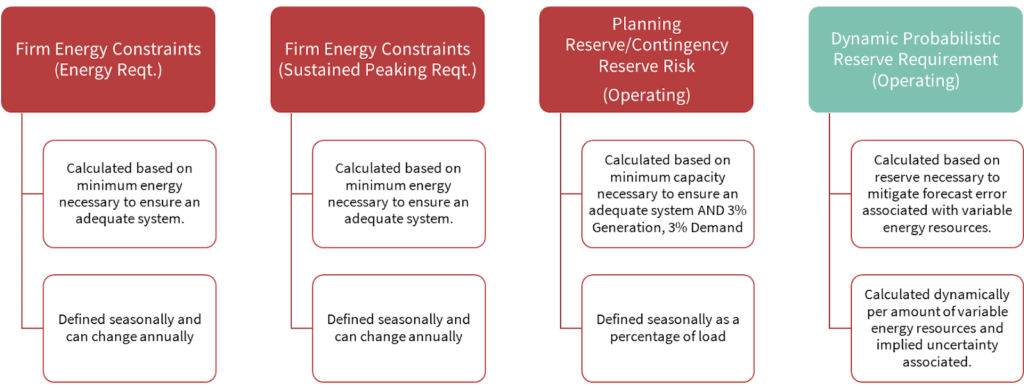
Figure 1 – source: NWPCC SAAC Meeting⁶
The resulting adequacy signals enter OptGen through multiple complementary channels: typical-day load profiles set the hourly demand shape; planning and operating reserves ensure short-term reliability; monthly firm energy constraints signal the need for resources capable of sustained output; and firm peaking requirements capture longer-duration stress conditions. This layered approach ensures that the expansion model receives adequacy information from multiple angles, rather than relying on a single constraint that could be satisfied in an unrealistic way.
As an additional validation step, the Council plans to run OptGen portfolios back through GENESYS to confirm that the resulting resource mixes meet adequacy standards under the full set of simulated conditions.
⁵ Genesys (Generation Evaluation System) is a probabilistic adequacy model originally developed by the NWPCC in 1999 and redeveloped by PSR in 2020, with enhanced capabilities including hourly hydro dispatch, dynamic market pricing, and multi-stage resource commitment
⁶ http://nwcouncil.box.com/s/vqpejnpu7tsoqygjloqrdp5e6ytbpcgq
Dynamic reserves for a changing resource mix
A distinctive aspect of the Council’s methodology is the treatment of operating reserves. In a system where the share of variable energy resources is growing, the amount of reserves needed to manage variability and uncertainty is not fixed — it changes with the resource mix itself.
To address this, the NWPCC uses the Dynamic Probabilistic Reserve (DPR) methodology developed by PSR, where reserve requirements increase or decrease depending on the forecasted availability of wind and solar generation. Rather than treating reserves as a static exogenous input, the DPR is calculated independently for each reserve planning area (Northwest, California, Mountain West, Southwest, and Canada) based on the variable energy resources within that area. Qualifying reserve resources include existing and new thermal plants, hydro units, and short-, medium-, and long-duration storage.
This dynamic representation is particularly important because, as optimization adds more renewables to the system, the reserve requirement adjusts accordingly — creating a feedback loop that more realistically reflects the operational cost of integrating variable generation at scale.
From 13,500 futures to a tractable problem
Perhaps the most consequential methodological challenge in the Ninth Power Plan is managing the huge number of possible futures. Combining all available uncertainty streams — 90 hydro/VER sequences, 15 demand trajectories, 30 gas price paths, and three climate model datasets — produces over 13,500 unique future combinations. Running a stochastic optimization model across all of them for each year is computationally demanding.
The Council’s solution was to select representative futures using a constrained linear programming approach. The team initially explored K-Means clustering but found that random selection from within clusters did not guarantee balanced representation across all uncertainty dimensions — particularly across load pathways and climate model datasets.
The final selection method uses a linear program that applies a set of hard and soft constraints: one future from each 10-percentile bin of net load (annual load minus hydro and VER generation); one from each 10-percentile bin of hydro conditions; a balanced mix of gas prices (four mid-range, three high, three low) with diversified volatility; equal representation of the five load pathways; and a fixed distribution across the three climate scenarios. The objective function minimizes the distance to the population mean within each constraint group.
The Council emphasized that this clustering targets the economic risk space; adequacy signals, which are derived from GENESYS using the full set of 90 hydrological simulations, are not directly affected by the clustering.
Insights for power system planning
The NWPCC’s approach to the Ninth Power Plan illustrates how a complex, real-world planning problem can be structured into a tractable analytical process without oversimplifying the system. By combining layered adequacy signals, dynamic reserves, and a rigorous uncertainty sampling strategy, the Council has assembled a framework that captures the interactions between investment decisions, operational constraints, and policy requirements.
What stands out in this case is not a single modeling feature, but the overall design of the analytical workflow — how each methodological choice was calibrated to address a specific aspect of the planning while keeping the problem computationally manageable. The result is a planning process that can explore a wide range of resource strategies across hundreds of future conditions, providing the Council with the analytical foundation needed to make robust long-term decisions for the Pacific Northwest.