







The Central Asian power sector is undergoing a structural realignment. Against a backdrop of rising electricity demand, legacy infrastructure, and an urgent need to expand renewable generation, two World Bank-backed hydropower projects — Rogun Dam in Tajikistan and Kambarata-1 in Kyrgyzstan — stand out both in scale and systemic implications. Together, they involve over USD 10 billion in investments and are poised to reshape the regional energy landscape.
Hydropower remains one of the region’s most underexploited assets. Despite significant technical potential, decades of underinvestment and coordination challenges have delayed large-scale developments. Rogun and Kambarata-1 are outliers in this context. They are not only the largest energy infrastructure projects in their respective countries but are also central to regional efforts to integrate power markets and strengthen export capacity.
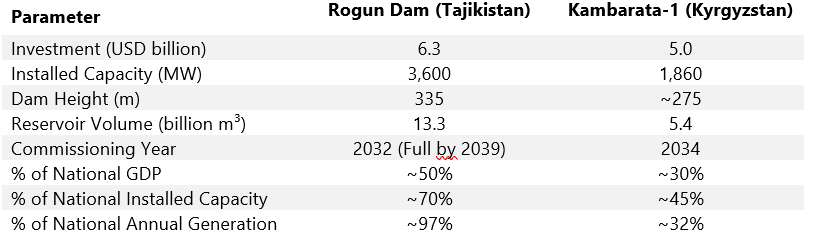
Rogun Dam, currently under construction on the Vakhsh River, is projected to reach 335 meters, making it the tallest dam in the world upon completion. With 3,600 MW of installed capacity and a 13.3 billion m³ reservoir, it will eventually generate nearly 97% of Tajikistan’s current electricity demand. Full reservoir operation is expected by the end of the 2030s, with phased commissioning through the decade. Kambarata-1, on the Naryn River in Kyrgyzstan, will contribute 1,860 MW and 5.4 billion m³ of storage, adding roughly 32% to national generation. Its commissioning is planned for 2034.
From an economic standpoint, the projects represent a substantial share of GDP: about half for Tajikistan and one-third for Kyrgyzstan. In this context, robust system modeling and export market analysis are essential — not only to inform design and financing decisions, but to ensure resilience in countries with limited fiscal space and exposure to climate and hydrological variability.
Projects Snapshot – Key Parameters
Both projects are designed to go beyond domestic energy supply. They are structured to enable regional exports to neighbors such as Kazakhstan, Uzbekistan, Afghanistan and Pakistan — an ambition that depends on expanded interconnection capacity and integrated operational planning. The modeling effort behind this strategy is detailed in the following sections.
Energy System Modeling
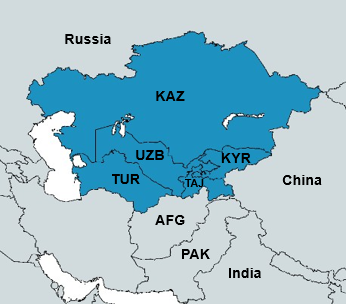
The long-term viability of large-scale hydropower in Central Asia hinges not only on civil works and financing structure, but on how well these assets integrate into a broader, export-oriented power system. To address this, the modeling effort by PSR covered the entire Central Asian region, with detailed datasets for Kazakhstan, Uzbekistan, Kyrgyzstan, Turkmenistan, and Tajikistan, and simplified representations of Afghanistan, Pakistan, and southern Russia. The objective: simulate generation expansion and cross- border transmission flows under a range of hydrological, economic, and policy scenarios.
The generation database includes over 300 renewable sites — both existing and candidate — across technologies and geographies. Capacity estimates reflect spatial resource quality and project-level constraints, helping to avoid overoptimistic supply assumptions. Demand projections incorporate seasonal variation and structural economic shifts, while transmission modeling accounts for grid topology, interconnection limits, and future reinforcement scenarios.
Results point to a clear transition: from a system still heavily reliant on coal and inefficient gas plants toward one increasingly dominated by renewables and more efficient dispatchable units. In particular, Kazakhstan is set to emerge as a regional wind power exporter, supported by new nuclear capacity, while Tajikistan and Kyrgyzstan will leverage their hydro assets to supply clean firm energy to neighboring systems.
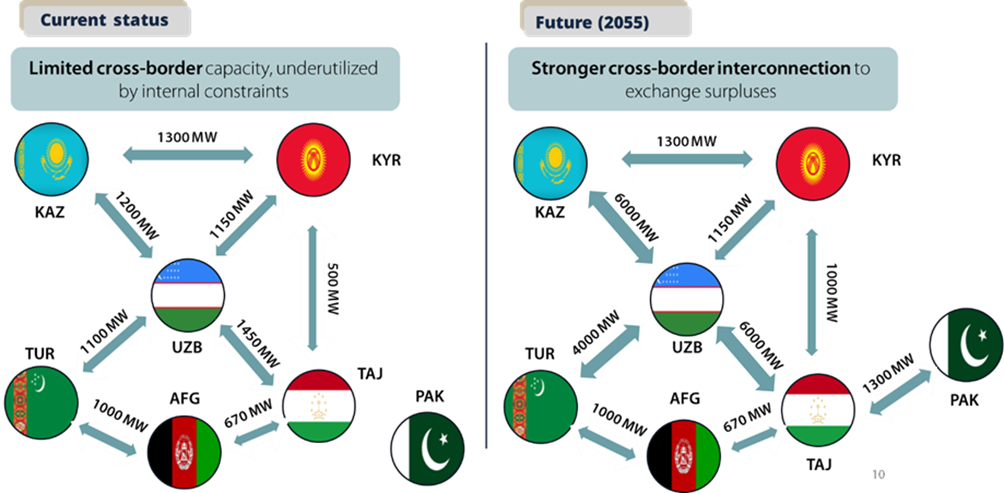
The analysis also shows that current interconnection limits are a key constraint. Transmission upgrades
— especially east-west corridors and north-south links to Pakistan and Afghanistan — are required to enable efficient seasonal balancing and export flows. Hydrological diversity can be monetized only if physical exchange infrastructure is in place.
To emulate a realistic expansion from each country, their expansion plans were initially modeled independently, without assumed imports. Only then were transmission investments simulated to identify optimal reinforcements. This ensures that no country would expand their system heavily relying in their neighbors, and exchanges would be opportunistic. Final runs combined all assets into an integrated system, with full operational dispatch, investment sequencing and reliability constraints. The modeling used PSR’s OPTGEN-SDDP platform, with hourly granularity, dynamic reserve margins, grid stability constraints, and probabilistic hydro inflows and renewable production.
Institutional Challenges and Regional Impact
Despite their technical appeal, both Rogun and Kambarata-1 face significant political and cooperative hurdles. Water governance in Central Asia remains highly sensitive, rooted in decades of tension over transboundary river usage. Uzbekistan, in particular, initially opposed Rogun’s construction, citing concerns over downstream irrigation impacts. Progress required years of regional dialogue and international mediation, with the World Bank playing a key role in facilitating basin-level coordination.
The projects are now framed not only as energy ventures but as instruments of regional stabilization. Beyond electricity generation, they contribute to a rebalancing of water-energy linkages across the Amu Darya and Syr Darya basins. Hydropower operation planning is being aligned with seasonal water releases for agriculture, especially during summer peaks — helping to reduce friction between upstream and downstream countries.
From an energy security perspective, the new hydropower capacity provides clean, firm generation that complements the intermittent nature of solar and wind. It also stabilizes system frequency and supports synchronous grid operations across countries with weak reserve margins. This is particularly relevant in Uzbekistan and Afghanistan, where rapid demand growth and network fragilities limit system flexibility.
Economically, regional electricity trade enabled by these projects could unlock billions in net benefits. By exporting surplus hydro during the wet season and importing back during dry periods, countries can optimize seasonal exchanges and reduce thermal backup needs. For Tajikistan and Kyrgyzstan, export revenues are essential to cover debt service on the projects. For buyers like Pakistan and Afghanistan, imports offer a cheaper and cleaner alternative to inefficient thermal generation or deferred capacity investment.
The geopolitical stakes are also shifting. As regional infrastructure becomes more interdependent, incentives for cooperative behavior increase. Electricity trade acts as a stabilizer: curbing fragmentation, creating mutual dependencies, and reducing the risk of unilateral action on water flows. In this sense, energy interconnection becomes both an economic enabler and a diplomatic tool.
Final Considerations
Hydropower in Central Asia is moving from strategic potential to operational backbone. Rogun and Kambarata-1 are not isolated mega-projects, but components of a systemic shift toward renewable- based regional integration. Their success depends on more than civil works or financing terms — it requires robust modeling, transparent governance, and credible coordination platforms.
The modeling frameworks used in these projects demonstrate how technical analysis can support high- stakes decision-making in politically complex environments. By simulating long-term scenarios with OPTGEN-SDDP — accounting for realistic constraints and intertemporal dynamics — planners were able to stress-test expansion pathways and quantify trade-offs between domestic supply, exports, and system reliability.
As interconnections expand and energy systems become more intertwined, the value of integrated planning increases. Clean energy, when deployed with precision and cross-border alignment, becomes more than a climate solution — it becomes a development strategy and a vector of regional cooperation. These two hydropower projects signal the start of that transition.